%20--%3e%3csvg%20version='1.1'%20id='Layer_1'%20xmlns='http://www.w3.org/2000/svg'%20xmlns:xlink='http://www.w3.org/1999/xlink'%20x='0px'%20y='0px'%20viewBox='0%200%2052.8%2052.8'%20style='enable-background:new%200%200%2052.8%2052.8;'%20xml:space='preserve'%3e%3cstyle%20type='text/css'%3e%20.st0{fill:%23D70036;}%20.st1{fill:%234B4F54;}%20%3c/style%3e%3cpath%20class='st0'%20d='M22.1,27.8L49.9,0.4C49.3,0.1,48.7,0,48,0H4.8C2.2,0,0,2.2,0,4.8V48c0,2.6,2.2,4.8,4.8,4.8h20.8v-0.1%20c2.9,0,5.5-1.4,7.4-3.6c2.1-2.3,3.4-5.4,3.4-8.5c0-3-1.2-5.7-3.2-7.6c-2-2-4.6-3.2-7.6-3.2c-0.4,0-0.8,0-1.1,0.1%20c-0.4,0-0.7,0.1-1.1,0.2l-4.6,1.1L22.1,27.8z'/%3e%3cpath%20class='st1'%20d='M51.9,2.1L26.5,27.2c3.3,0.2,6.3,1.7,8.6,3.9c2.4,2.4,3.9,5.8,3.9,9.5c0,1-0.1,2-0.3,2.9L52.8,5.4V4.8%20C52.8,3.8,52.5,2.9,51.9,2.1'/%3e%3c/svg%3e)


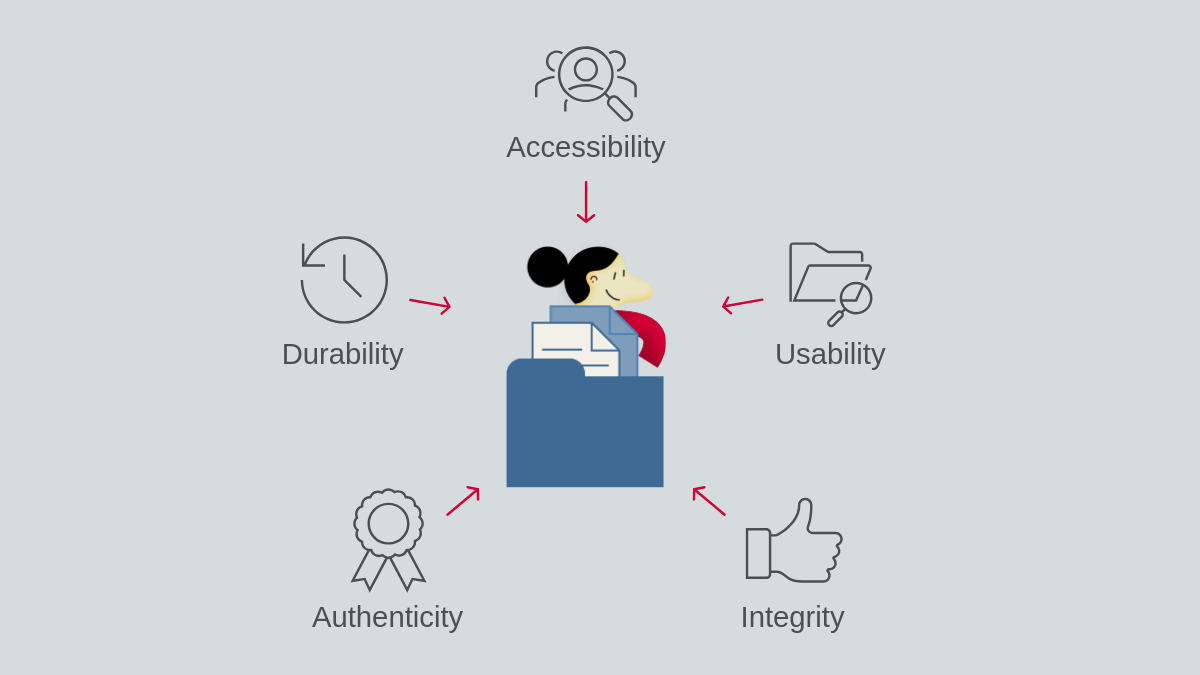
Secure electronic document archiving is based on five key principles: accessibility, usability, integrity, authenticity, and durability.
These principles determine whether an archived document remains usable, unchanged, accessible only to authorized users, and reliable enough to serve as evidence even years later.
In long-term document archiving, the key question is not only where a document is stored. The real question is whether the system ensures that the document retains its value throughout the entire retention period.
Why are the principles of electronic archiving important?
Documents kept in electronic archiving systems often have a long lifecycle. During that time, systems, users, processes, organizational structures, file formats, and legal requirements may change.
That is why an organization must be able to answer several key questions:
Who has access to the documents?
Are the documents still readable?
Has the content remained unchanged?
Can the origin of the document be proven?
Are these conditions maintained throughout the full retention period?
The five principles of secure electronic archiving help answer these questions.
Overview of the 5 principles of electronic archiving
1. Accessibility: the document must be available to the right people
Accessibility means that documents in electronic archiving are available when the organization needs them, but only to authorized users.
This principle is important for daily work, audits, internal reviews, inspections, and compliance evidence. A document that cannot be found or accessed in time quickly loses its practical value.
At the same time, access must not be open to everyone. Many documents contain personal, confidential, or business-sensitive information. Access must therefore be managed through roles, permissions, and traceability of views and actions.
What to check in practice:
Are access rights assigned based on roles?
Is it clear who can view or use a document?
Can the organization verify who accessed the document?
Are access rights regularly reviewed and aligned with user responsibilities?
2. Usability: the document must remain readable over time
Usability means that the content of a document remains readable, understandable, and usable throughout the entire retention period.
This is especially important for documents that must be retained for many years or permanently. Technology changes, software becomes outdated, information systems are replaced, and some file formats are no longer supported over time.
If a document cannot be opened ten years later, the fact that it was formally stored does not help much.
Electronic archiving must therefore support long-term file formats, metadata management, and searchability across archived documentation.
What to check in practice:
Are documents converted into formats suitable for long-term archiving?
Are metadata structured enough to support search and interpretation?
Can the document be opened outside the original system?
Does the system support long-term usability of documents?
3. Integrity: the content must remain unchanged
Integrity means that a document remains complete and unchanged while it is archived.
The organization must be able to prove that the document has not been unlawfully modified, supplemented, deleted, or replaced from the moment it entered the archive.
This is essential for the evidentiary value of a document. If there is doubt about whether the content has been changed, the reliability of the document becomes questionable.
Integrity is ensured through technical and organizational mechanisms such as audit trails, timestamps, electronic signatures, digital seals, and control mechanisms.
What to check in practice:
Does the system prevent unauthorized changes?
Are actions on documents recorded?
Can the organization prove that the content has remained unchanged?
Are changes to metadata traceable?
4. Authenticity: the origin of the document must be provable
Authenticity means that it is possible to prove that the document is what it claims to be.
In electronic archiving, it is not enough for a document to exist. The organization must be able to confirm its origin, the time of its creation or archiving, its connection to the relevant process, and its state when it entered the archive.
Authenticity is directly connected to trust in the document. If it is not clear where the document comes from or whether it is linked to the correct business event, its evidentiary value is reduced.
Timestamps, electronic signatures, metadata, and audit trails play an important role in ensuring authenticity.
What to check in practice:
Is it clear who created, approved, or archived the document?
Is the time of archiving recorded?
Is the document linked to the correct process or case?
Can the authenticity of the document be proven over time?
5. Durability: all principles must apply throughout the full retention period
Durability means that accessibility, usability, integrity, and authenticity must be maintained throughout the entire retention period.
It is not enough for a document to be secure and properly managed when it is archived. The same must remain true five, ten, twenty years later, or longer, depending on the document type and applicable retention rules.
Durability connects all other principles. It ensures that a document does not lose its value because of outdated formats, unclear access rights, missing metadata, or poorly managed disposal procedures.
What to check in practice:
Does the system track retention periods?
Is document disposal controlled?
Is long-term usability regularly reviewed?
Are archiving procedures aligned with internal rules and applicable regulations?
What happens if these principles are not ensured?
If one of the principles fails, the document may still exist, but its value is no longer the same.
The most common consequences are:
the document cannot be found,
the document cannot be opened,
it is not clear which version is valid,
it cannot be proven that the content has remained unchanged,
access is not traceable,
the document is not suitable for proving compliance.
The principles of electronic archiving are therefore not just technical recommendations. They are the foundation of long-term trust in documents.
- Accessibility | The document is available to authorized users.
- Usability | The document remains readable and understandable over time.
- Integrity | The content remains unchanged.
- Authenticity | The origin and authenticity of the document can be proven.
- Durability | All principles apply throughout the full retention period.
Principles as a basis for compliant document management
Organizations operating in regulated or document-intensive environments must treat documents as part of accountability, compliance, and evidence.
The principles of secure electronic archiving provide a framework for checking whether documents are truly archived properly: whether they are accessible, readable, unchanged, authentic, and valid over time.
When a document is needed as evidence, it is not enough that it exists. What matters is whether it can be trusted.
If you want to see how InDoc EDGE can help you establish secure, traceable, and compliant electronic document archiving, contact us.