%20--%3e%3csvg%20version='1.1'%20id='Layer_1'%20xmlns='http://www.w3.org/2000/svg'%20xmlns:xlink='http://www.w3.org/1999/xlink'%20x='0px'%20y='0px'%20viewBox='0%200%2052.8%2052.8'%20style='enable-background:new%200%200%2052.8%2052.8;'%20xml:space='preserve'%3e%3cstyle%20type='text/css'%3e%20.st0{fill:%23D70036;}%20.st1{fill:%234B4F54;}%20%3c/style%3e%3cpath%20class='st0'%20d='M22.1,27.8L49.9,0.4C49.3,0.1,48.7,0,48,0H4.8C2.2,0,0,2.2,0,4.8V48c0,2.6,2.2,4.8,4.8,4.8h20.8v-0.1%20c2.9,0,5.5-1.4,7.4-3.6c2.1-2.3,3.4-5.4,3.4-8.5c0-3-1.2-5.7-3.2-7.6c-2-2-4.6-3.2-7.6-3.2c-0.4,0-0.8,0-1.1,0.1%20c-0.4,0-0.7,0.1-1.1,0.2l-4.6,1.1L22.1,27.8z'/%3e%3cpath%20class='st1'%20d='M51.9,2.1L26.5,27.2c3.3,0.2,6.3,1.7,8.6,3.9c2.4,2.4,3.9,5.8,3.9,9.5c0,1-0.1,2-0.3,2.9L52.8,5.4V4.8%20C52.8,3.8,52.5,2.9,51.9,2.1'/%3e%3c/svg%3e)

Streamline information chaos
Improve your document management for easier collaboration and regulatory compliance with less risk.

Easier work with instant benefits
higher
employee efficiency with streamlined document management.
saved every week
by your most creative coworkers with effortless information retrieval.
employees
are more satisfied when content management procedures are clear and transparent.
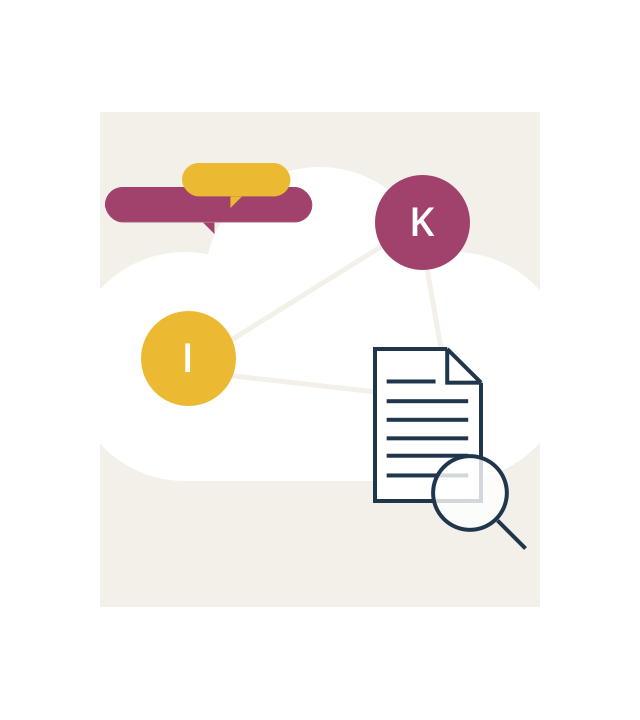
Right information at the right time
- Search for information by name, metadata, content, or type
- Use common and specific search engines or simply create advanced search queries
- Comment on content or sign up for notifications
- Engage in content within and outside the organization
- Enable collaborative document editing in Microsoft Office for the web
employees edit, review, and collaborate on document content using email...
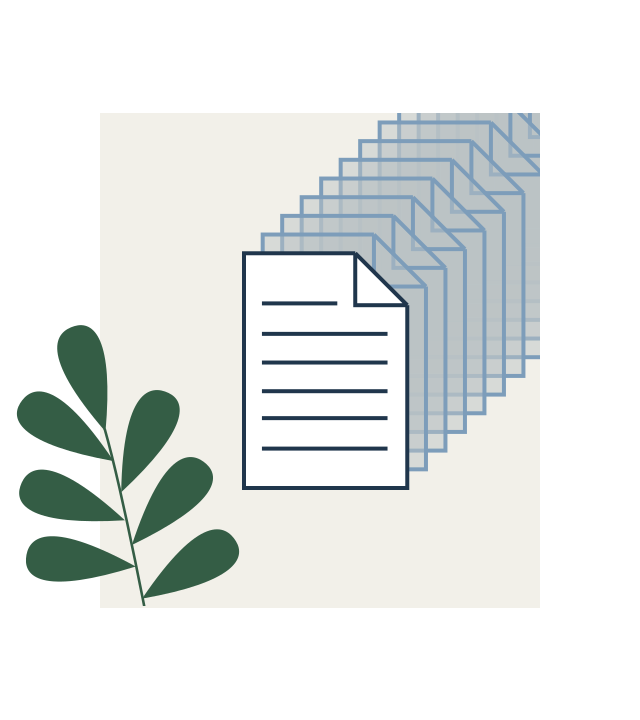
Organize content to suit your needs
- Create documents from templates
- Add metadata manually or through APIs
- Use a regulated, free, or combined folder structure
- Link documents and prevent content duplication
- Invite coworkers to edit, review, and approve content
"We have finally found a tool that puts us in control of a large number of agreements and helps us manage our contractual obligations."

Enhance transparency for easy use
- Set up access rights for folders, case folders, and documents
- Choose from six levels of security access
- Restrict access to content with personal data
- Ensure automated document version updates
- Request confirmation regarding content suitability
- Review document history and previous versions at any time
Feature overview
Creation or capture
Create, capture, or add documents in various ways.
Content access
Store files and access content from any device.
Document storage
Preserve document validity until retention expiry.
Content organization
Structure content with metadata manually or via APIs.
Version control
Manage versions to maintain control of content.
Integration
Integrate with other business apps using open APIs.