%20--%3e%3csvg%20version='1.1'%20id='Layer_1'%20xmlns='http://www.w3.org/2000/svg'%20xmlns:xlink='http://www.w3.org/1999/xlink'%20x='0px'%20y='0px'%20viewBox='0%200%2052.8%2052.8'%20style='enable-background:new%200%200%2052.8%2052.8;'%20xml:space='preserve'%3e%3cstyle%20type='text/css'%3e%20.st0{fill:%23D70036;}%20.st1{fill:%234B4F54;}%20%3c/style%3e%3cpath%20class='st0'%20d='M22.1,27.8L49.9,0.4C49.3,0.1,48.7,0,48,0H4.8C2.2,0,0,2.2,0,4.8V48c0,2.6,2.2,4.8,4.8,4.8h20.8v-0.1%20c2.9,0,5.5-1.4,7.4-3.6c2.1-2.3,3.4-5.4,3.4-8.5c0-3-1.2-5.7-3.2-7.6c-2-2-4.6-3.2-7.6-3.2c-0.4,0-0.8,0-1.1,0.1%20c-0.4,0-0.7,0.1-1.1,0.2l-4.6,1.1L22.1,27.8z'/%3e%3cpath%20class='st1'%20d='M51.9,2.1L26.5,27.2c3.3,0.2,6.3,1.7,8.6,3.9c2.4,2.4,3.9,5.8,3.9,9.5c0,1-0.1,2-0.3,2.9L52.8,5.4V4.8%20C52.8,3.8,52.5,2.9,51.9,2.1'/%3e%3c/svg%3e)

INTEGRATION
Connect tools to achieve your business goals
Say NO to the fragmentation of your information system and leverage connectivity to unlock your digital potential.

Integration is key to team performance

PERFORMANCE
Automate workflows to improve efficiency
- Use our APIs to manage content and tasks, as well as to add and access content directly from your business systems
- Seamlessly connect your workflows with services from other providers to optimize performance and improve digital CX
- Maintain oversight with a comprehensive audit trail
69%
of clients expect better connected experiences...
9 out of 10
clients expect organizations to accelerate their digital initiatives...
Source: Salesforce, 2021

SECURITY
Welcome external parties into your flows
- Protect your content across different applications of your organization
- Connect content and tasks with other systems and services in a secure and legally compliant manner
- Engage external parties in your processes while maintaining information security and meeting legal compliance
"With InDoc EDGE, we've simplified the procedure for consenting to organ donation process and allowed for consents to be submitted electronically. The number of organ donation consents has been increasing ever since!"
Dr. Boštjan Kušar, Slovenija-transplant
Assistant director
Get access to the integration APIs
USABILITY
Enable your teams to focus on the relevant
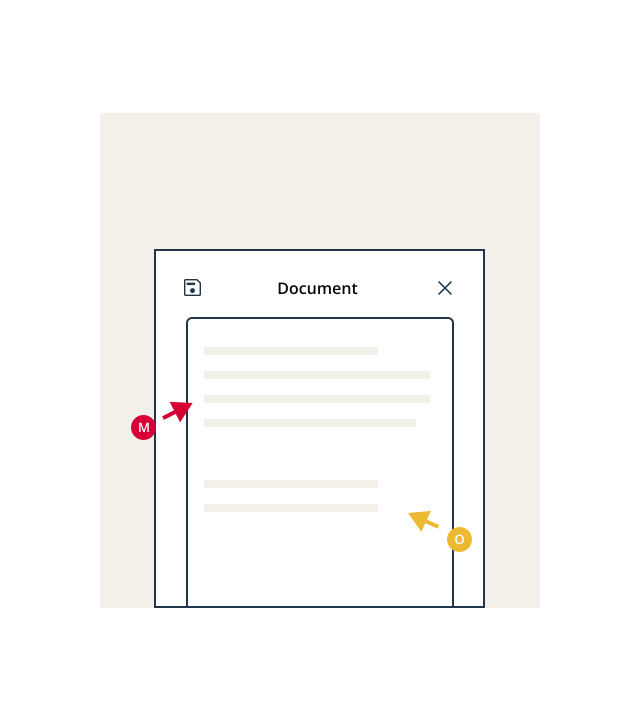
- Connect your documents and content with the centralized document storage
- Display content in your preferred tool while maintaining context and user interfaces you are accustomed to
- Edit content in Microsoft Office tools directly from InDoc EDGE and avoid versioning issues
75%
of knowledge workers agree that the excess of non-integrated apps is hampering their team's productivity.
Source: Gmelius, 2021
FAQ
Explore related content



Connect your tools and teams to win