%20--%3e%3csvg%20version='1.1'%20id='Layer_1'%20xmlns='http://www.w3.org/2000/svg'%20xmlns:xlink='http://www.w3.org/1999/xlink'%20x='0px'%20y='0px'%20viewBox='0%200%2052.8%2052.8'%20style='enable-background:new%200%200%2052.8%2052.8;'%20xml:space='preserve'%3e%3cstyle%20type='text/css'%3e%20.st0{fill:%23D70036;}%20.st1{fill:%234B4F54;}%20%3c/style%3e%3cpath%20class='st0'%20d='M22.1,27.8L49.9,0.4C49.3,0.1,48.7,0,48,0H4.8C2.2,0,0,2.2,0,4.8V48c0,2.6,2.2,4.8,4.8,4.8h20.8v-0.1%20c2.9,0,5.5-1.4,7.4-3.6c2.1-2.3,3.4-5.4,3.4-8.5c0-3-1.2-5.7-3.2-7.6c-2-2-4.6-3.2-7.6-3.2c-0.4,0-0.8,0-1.1,0.1%20c-0.4,0-0.7,0.1-1.1,0.2l-4.6,1.1L22.1,27.8z'/%3e%3cpath%20class='st1'%20d='M51.9,2.1L26.5,27.2c3.3,0.2,6.3,1.7,8.6,3.9c2.4,2.4,3.9,5.8,3.9,9.5c0,1-0.1,2-0.3,2.9L52.8,5.4V4.8%20C52.8,3.8,52.5,2.9,51.9,2.1'/%3e%3c/svg%3e)

Electronic document archiving
A document being stored is not enough. What matters is whether you can trust it. Even years later. Electronic document archiving ensures traceability, control and the legal validity of documents throughout the entire retention period.

What happens when archiving is not properly managed?
Most organizations store documents. Fewer preserve them in a way that keeps them trustworthy over time.
Risks appear when:
- a document can no longer be opened,
- it cannot be proven that the content has not been changed,
- it is unclear who accessed the document and what happened to it,
- retention periods are not properly monitored.
These are not just storage issues. They are issues of evidentiary value, compliance and control.
What is electronic document archiving?
Electronic document archiving is the systematic, long-term preservation of documents in a way that ensures their usability, authenticity, integrity and legal validity throughout the entire retention period.
It is not just a matter of technology. It is a combination of rules, processes and controls - from document capture to disposal.
A stored document is not evidence
Storage means that a document exists.
Electronic archiving means that you can prove:
- that the document is authentic,
- that it has not been changed,
- that it remains readable and legally valid over time.
If you cannot prove this, the document loses its evidentiary value - no matter how many copies you have.
Can the document clearly prove what it needs to prove?
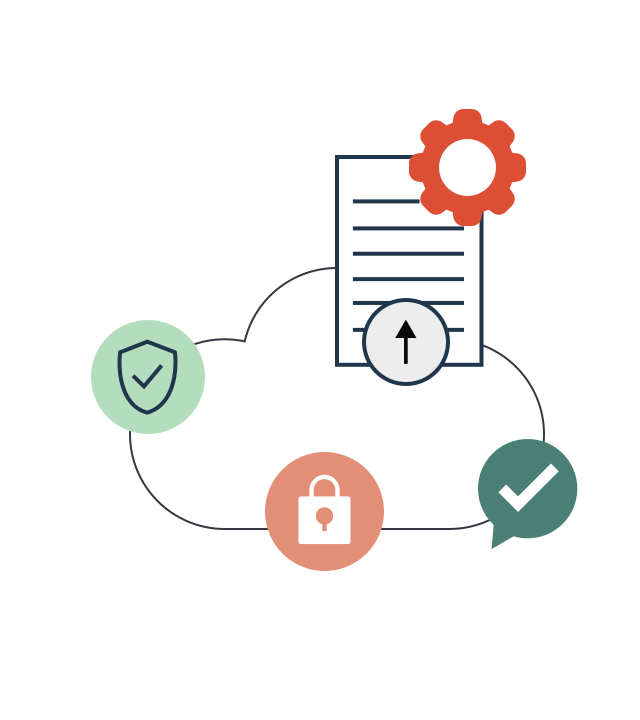
How does electronic document archiving work?
Document capture
Documents are captured from different sources together with metadata for classification and search.
Document management
Control over versions, access rights, collaboration, approvals and electronic signing.
Long-term archiving and preservation
Completed documents are automatically archived for long-term preservation, with protection, traceability, timestamping and conversion into suitable long-term formats.
Disposal
Controlled disposal of documents after the retention period has expired.
What is electronic archiving based on?
Electronic archiving is based on principles that ensure a document remains trustworthy throughout the entire retention period.
These principles define:
- who has access,
- how integrity is ensured,
- how the document remains readable,
- how legal validity is preserved.
See all 5 principles of electronic document archiving
Key electronic archiving capabilities
in InDoc EDGE
Accessibility
Controlled access to documents with clearly defined roles and permissions.
Integrity
Ensured integrity and unchanged content throughout the entire retention period.
Durability
Documents retain their legal validity throughout the entire lifecycle.
Certification
Electronic archiving certified by the Archives of the Republic of Slovenia
Authenticity
Provable document origin through timestamps and traceability.
Integration
Direct transfer of documents from business systems into electronic archiving.
Banking and financial services
Banks, insurance companies and other financial institutions manage extensive contractual and regulatory documentation that must be retained in accordance with supervisory requirements. Electronic archiving ensures that these documents remain traceable, unchanged and legally valid during audits, inspections or legal proceedings.
“Integrating business applications with e-archiving in InDoc EDGE enables quick yet controlled access to information when needed.”
Healthcare
Healthcare institutions must demonstrably manage quality management system documentation, including records of nonconformities, corrective actions and audits.
Electronic archiving ensures that these documents are consistently archived, traceable and unchanged, which is essential for proving compliance during external and internal audits.
The same applies to healthcare documentation in the broader sense, from patient records to medical reports, which requires long-term retention under strict personal data protection requirements.
This level of control is especially important during external audits and inspections, where an institution must be able to prove at any time that documentation has been managed in accordance with regulations.
Manufacturing and logistics
Manufacturing and logistics companies manage technical documentation, quality certificates and supplier contracts that must be traceable throughout the entire product lifecycle. Electronic archiving ensures traceability, integrity and quick access to documentation during audits, claims or supplier disputes.
“We primarily chose InDoc EDGE as a central system for archiving HR, procurement and financial documents, and later expanded its use with solutions for business functions.”

What do you gain with electronic document archiving?
- Greater evidentiary value
Documents remain traceable, authentic and unchanged throughout the entire retention period.
- Reduced business risk
Controlled archiving reduces risks during audits, inspections and legal proceedings.
- Better compliance and security
Audit trails, access control and certified electronic archiving support compliant business operations.
- More efficient management
Automated archiving, retention periods and controlled disposal reduce manual work.
Electronic archiving in InDoc EDGE helps organizations maintain control, traceability and the legal validity of documentation throughout the entire retention period.